

Billboard advertising does not come with a standard price tag, and for most businesses, the first question is simple: how much does a billboard cost? A static face in a small Georgia town and a digital display on a major Atlanta interchange can differ by tens of thousands of dollars per month, and both numbers can be justified depending on what a campaign needs to accomplish. Understanding what drives that range makes it far easier to plan a realistic budget and compare options without guessing.
Knowing the main cost factors, what supporting expenses to plan for, and how to measure placement value puts you in a much stronger position before the first quote arrives.
What Actually Drives Billboard Pricing
Three variables have the greatest influence on billboard costs.
- Location — High-demand corridors in major metros carry premium rates because competition for those faces is real and inventory is limited. In smaller markets or on secondary routes, rates drop significantly, which can work in your favor if your audience is concentrated in those areas. Popular billboard locations across the U.S. reflect exactly that kind of demand variation.
- Format — Static and digital billboards are priced differently because they serve different functions. Static displays give exclusive use of a face for the rental period. Digital units sell a share of rotation at a higher base rate, but allow time-sensitive messaging and creative updates without reprinting vinyl.
- Traffic volume — Operators price inventory based on estimated impressions, and higher-traffic corridors command higher rates. That said, raw traffic count is not the same as audience quality. A moderately traveled road with the right commuter profile can outperform a busier highway where the audience does not match your buyer. Billboard visibility factors like sightlines and approach speed play a bigger role in real-world performance than impression counts alone.
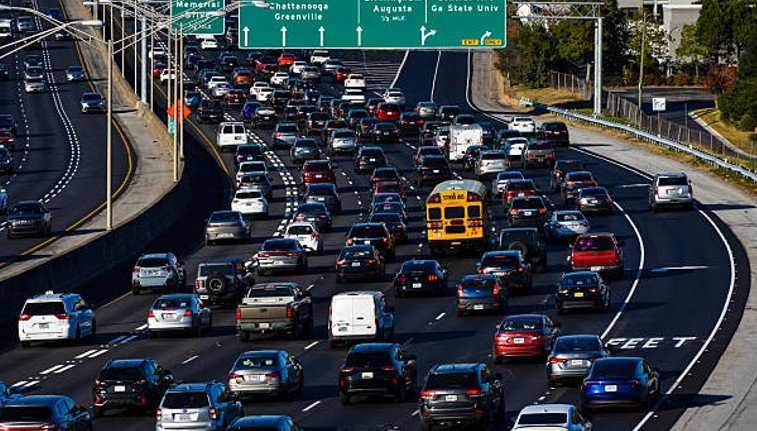
All three factors interact. A high-traffic location in the wrong market or the wrong format for your campaign goal can still yield poor results. The strongest placements align all three.
How Much Does a Billboard Cost Across Different Markets
Ranges in out-of-home advertising are wide but follow a consistent logic. Static billboards in smaller markets start around $250 to $500 per four-week period. Mid-size cities run $1,500 to $5,000 depending on the corridor. Top-tier placements on major Atlanta highways can reach $10,000 to $25,000 or more for the same window.
Digital rates follow similar geographic logic but start higher, commonly ranging from $1,200 to over $20,000 for premium urban inventory. The full breakdown of highway billboard costs by traffic volume helps put those numbers in context before comparing quotes.
Poster billboards come in at lower price points than bulletins, making them a strong option for brands that need neighborhood-level reach or broader coverage within a tighter budget. The difference between bulletin and poster billboards is a useful starting point when comparing formats for the first time.
The Line Items That First-Time Buyers Often Miss
The rate in a quote covers the space itself. What many businesses miss are the supporting costs that complete the campaign.
For static displays, vinyl production, installation, and takedown are real line items that operators sometimes separate from the base rate. On the digital side, artwork needs to meet specific file specs and resolution requirements. If your creative is not already built to those standards, account for the cost to prepare it.
First quotes often reflect only the rental. Your planning budget should always include a line for production and creative preparation alongside the media cost.
How Much Does a Billboard Cost Depending on Billboard Type
Format selection shapes more than just the base rate. It also determines how much production flexibility you have and whether your message can adapt mid-campaign.

- Digital billboards — Allow creative swaps with no additional production expense, which is valuable for promotions, seasonal offers, or campaigns targeting different audiences at different times of day.
- Transit and mall panels — Add another layer of choice for brands that want to reach audiences in higher-dwell environments at a generally lower price point than highway bulletins.
The format question is always tied to the campaign goal. Knowing what each type costs to run and maintain over time helps you build a budget that does not get revised mid-flight.
How to Evaluate Whether a Placement Is Worth the Price
Price alone is not the right benchmark. The more useful question is what a placement delivers relative to what it costs. That is where billboard CPM becomes a practical tool — cost per thousand impressions lets you compare placements of different sizes, formats, and markets on equal footing. A $3,000 billboard reaching 600,000 monthly impressions delivers very different value than a $3,000 placement reaching 90,000.
Billboard visibility factors like sightline distance, approach speed, and visual clutter also shape how many impressions actually register. A well-placed billboard on a slower arterial road can outperform a technically higher-traffic placement where drivers pass at 70 miles per hour with competing signs in the same field of view.
Why Full Inventory Access Changes the Budget Conversation
One of the most common budgeting mistakes businesses make is pricing based on a single vendor's available inventory. When you only see what one operator controls, you cannot benchmark fair pricing or identify stronger options nearby. You end up negotiating without leverage.
Working with a partner that has access to every billboard in every market changes that entirely. You can compare outdoor ad placement options across multiple operators, evaluate pricing against comparable faces, and make decisions based on strategy rather than availability. In competitive markets like Atlanta, where demand is high and quality inventory moves quickly, that access tends to produce better placements at better rates.
Reach out to Billboard Connection to review inventory, compare pricing across formats and corridors, and build a campaign plan around what your goals actually require.